 What is the bigger picture behind beauty aesthetics across the world?
Who were the pioneers of aviation?
Aberdeen Fiji Museum: Discovering the treasures – from one edge of the world to another
What is the bigger picture behind beauty aesthetics across the world?
Who were the pioneers of aviation?
Aberdeen Fiji Museum: Discovering the treasures – from one edge of the world to another
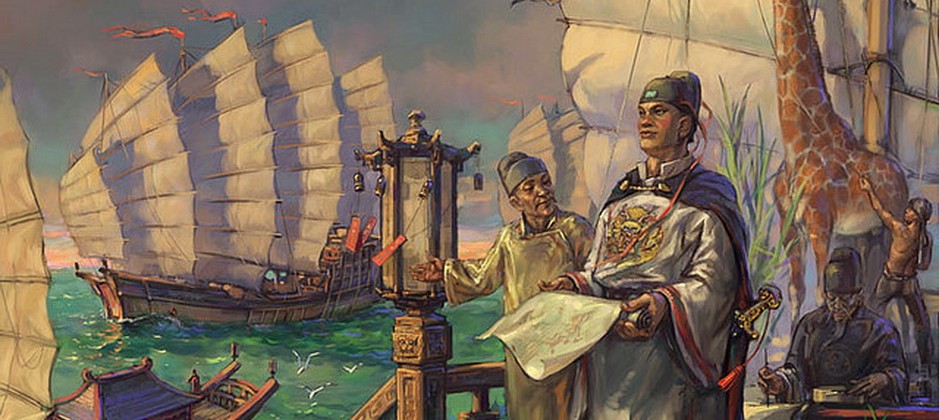
[1] A painting depicting the great Chinese Admiral, Zheng He. Welcome back. It’s been a long time since I have last written an article on here, and I wanted to do something different again
...This time, I wanted to explore medieval Chinese history and in particular, about the great Chinese Admiral called Zheng He (鄭和). The article is divided into five main sections – discussing about Zheng He’s profile, his expeditions, his impact during and after his voyages across the Asian, Indian and African shores. Finally, there will be some discussion of the nature of Zheng He’s voyages. I hope you enjoy this article, any constructive comments are more than welcome below! 1) Profile of Admiral Zheng He We start this article by looking at National Geography documentary, ‘Chinese Treasure Fleet: Adventures of Zheng He Documentary’. This show stars Japanese-American photographer and Asian studies scholar, Michael Yamashita, who travels according to each of Zheng He routes to understand the true magnitude of the voyage. I highly recommend you watching it, as it is very enticing and stimulating – here is the link: https://www.youtube.com/watch?v=Ckdn18SAldg. I am very interested in colonial history, so I thought it would be appropriate if I continued this article with something remarkable to consider. Normally, when you ask a person who was the pioneer of navigation to discover and create ripples around the world for more, the usual response would be Christopher Columbus, King Henry the Navigator of Portugal, or perhaps, the Vikings themselves for travelling the shores of what is modern-day Canada and the US. But I want to divert the focus of the Western colonial history and move towards a more Oriental approach and look at our main protagonist, Zheng He. Zheng He, or originally named Ma He, deriving from the Chinese version of Mohammed under the influence of his Persian and Muslim roots, was born in A.D. 1371 in Jinning, near the modern region of Yunnan Province. [3] When the young Ma He was only 10 years old, his dad was killed in a key battle between the Yuan and Ming clans (fighting around the East coast of China). [3] Consequently, captured by the victorious Ming clan, little Ma He was sent to Beijing and was turned into a eunuch. Zhu Di, the Prince of Yan, was the fourth son in line. Thus, many of the top eunuchs and officials refused to aid Zhu Di. This was significant, as this allowed Zheng He (as I shall call him hereafter), excelling in military studies and an imposing figure at what was believed to be 7 feet tall, came to the young emperor, Zhu Di’s aid, becoming closer and collaborate with many domestic and foreign policies. [3, 4] For example, this was shown when the both of them fought in the battle against the Mongol aggressors from the North. [3] 2) The Seven Expeditions of Zheng He [2] A map showing all seven journeys Zheng He made during c. 1405-33. Throughout approximately 28 years, Zheng He travelled to many countries, including those of: China Hainan Island Vietnam Siam Malaysia – Malacca Strait Indonesia Burma India Sri Lanka Persia Bengal Maldives Saudi Arabia Somalia Kenya Mozambique There were seven main expeditions that Zheng He had travelled on. Instead of listing out and recounting the voyages and in what years did Zheng He visit the particular, I thought I would pick out Malacca, as one of the few key areas from this list and discuss the impact/foreign relations that was initiated by the Admiral himself. If you would like to find out more details expedition by expedition, then do check out link 5 and 6 in the references below. 2.1) Malacca Malacca was one of the most important trading posts for the Chinese merchants. The Ming Emperor Yung-lo (1402-24) was initially very strict with the commercial activities externally, as he prohibited many private trading – feeling this would only augment the number of pirates across the South East Asian seas. [7] However, with the main document called the Yung-li Shih-lu (永樂實碌), was eventually convinced of the magnitude and profitability of the Malacca kingdom’s spice trade by South Indian Muslim merchants. As Chinese historian Wang Gungwu demonstrated in the Yung-li Shih-lu: “The ancient rulers honoured mountains and rivers, determined the boundaries, conferred nobility and set up feudal states in order to show special favour to the distant peoples and demonstrate no one is left out”. [7] Consequently, this was significant, as Malacca was one of the first areas for inscription and special recognition by the Emperor himself. He saw Malacca as a commercial hub, but a strategic one where China could expand its foreign relations within the 西洋 (literally Western Ocean) or Indian Ocean. [7] Thus, the increase of missions sent by the Emperor Yung-lo himself to various ports namely Java, Cochin (modern day Cambodia) and Siam (Thailand). 3) Impact – during his voyages During Zheng He’s expeditions, it was a continuation of the advanced trading and shipbuilding skills that the Chinese had developed since the 8th century, way before the age of Christopher Columbus. Let us start with the ship technology first. [5] The treasure ships, as they came to be known, were a symbol of the advanced technologies in China. Many of these ships were 400 feet long, 16 feet wide, with nine masts and 12 sails, fixed with double hulls as watertight compartments. [5] Putting all these dimensions into perspective, the Chinese ship was 4 to 5 times bigger than Columbus’ starship, the Santa Maria. The sheer size of these ships were a statement of intent by the Chinese Ming Emperor, showcasing the armada and Chinese glory to the world at large wherever they travelled to. This was one of the most effective technologies that the Chinese shipbuilders had, where they were could, using withstand leakage more readily. Consequently, less ships were lost this way and could continue efficiently navigating and trading. Another important impact that Zheng He had during his voyages was the trading he initiated. As the Chinese were more commercial navigators rather than expansionist and colonial ones as the time of Columbus in the late 15th and 16th centuries, many luxury items were traded with many Muslim, Indian and African merchants across these travels. 4) Impact – after Within the approximately 30 short golden years that Zheng He was commissioned to be the Chinese admiral, one main trait that remained was the Chinese diaspora and spread of Chinese culture into these lands themselves. [2] Today, there are major traces of Chinese population across Malaysia and Singapore and many festivals commemorating the Admiral himself as a god, primarily in Malaysia (Malacca), many islands scattering around Indonesia and other South Eastern countries still remain to this day. 5) Nature of Zheng He’s voyages – colonial or commercial? Contrary to common belief that Zheng He’s expeditions were positive and commercial, one major question that can be raised when discussing Zheng He’s voyages, is to ask whether they were out of colonial or commercial reasons. Dr Geoff Wade, an Australian scholar and fellow researcher at the National University of Singapore, presented his argument that Zheng He’s expeditions. [8] For example, Wade used his “majority” thesis, arguing that Zheng He’s 300 to 400 ships were largely warships and that with around 28,000 military troops, the admiral’s incentives were in fact colonial and expansionist. [8] Conversely, other historians like Tan Ta Sen disagree with Wade’s thesis; demonstrating that Zheng He in fact had a variety of ships and that this military troops were in fact for self-defence against pirates like Chen Zuyi (later arrested and executed by the imperial Ming court), across the Indonesian shores of Palembang, guarding against valuable goods and products like jewellery, silk and porcelain. [8] Effectively, during the time of Admiral Zheng He, the Chinese civilisation was technologically advanced with their shipbuilding skills and commercial activities with other countries. Many of these inventions like the double hull technology, greatly aided the Chinese fleet en masse to efficiently travel further. One of Zheng’s biggest remaining traits is the huge Chinese diaspora that has primarily expanded in the Malaysian Peninsula across Malaysia and Singapore. Elsewhere, his status as a great navigator and trader, has made him what has been perceived as a god-like figure in Malaysian and Indonesian festivals alike. Furthermore, with such an overwhelming fleet, scholars like Dr Geoff Wade argued that Zheng He’s expeditions were out of colonial, expansionist and influential incentives rather than simply the commonly perceived positive, commercial ones. I will leave you to decide which one it was and you can discover more in Leo’s Suryadinata’s edited book, Admiral Zheng He and Southeast Asia in sources 7 and 8 below. Finally, I wanted to end this article by asking a few reflective and counter-factual questions (as food for thought) so that it stays more interesting when you finish reading. If the Chinese had continued with their expeditions: 1) Would Zheng He have met European travellers (the pioneers of that area – say the Portuguese and Spanish)? How would that have changed the Chinese Emperor’s incentives? 2) And if the Chinese had more colonial interests rather than commercial/peaceful ones, how much and how different would that have changed the hegemonic theatre we have today (leaving the obvious point of a perhaps Chinese dominated world)? 3) How far would globalisation be shaped in the Chinese way, in this case? Hopefully, you enjoyed your read here. It’s been far too long since my last article. If you haven’t already, do check out my other articles on this site and see you soon around! 🙂 References [1] http://southbaysail.com/uploads/3/1/5/4/3154615/2142648_orig.jpg [2] https://www.youtube.com/watch?v=Ckdn18SAldg [3] http://asianhistory.about.com/od/china/p/zheng_he_bio.htm [4] http://www.china.org.cn/english/features/zhenhe/131897.htm [5] http://afe.easia.columbia.edu/special/china_1000ce_mingvoyages.htm#voyages [6] http://orias.berkeley.edu/pallop/timeline.html [7] Gungwu, W., “The Opening Relations between China and Malacca, 1403-05”, Chapter 1, in Suryadinata, L., Admiral Zheng He and Southeast Asia, http://books.google.co.uk/books?id=08b6HCoCCaAC&printsec=frontcover&dq=zheng+he&hl=en&sa=X&ei=cai4U8rWJ4mCkwX254CwCg&ved=0CCsQ6AEwAQ#v=onepage&q=zheng%20he&f=false, date of access: 06/07/2014, pages 1 to 25 [8] Tan, S. T., “Did Zheng He Set Out to Colonise Asia?”, Chapter 3, in Suryadinata, L., Admiral Zheng He and Southeast Asia, http://books.google.co.uk/books?id=08b6HCoCCaAC&printsec=frontcover&dq=zheng+he&hl=en&sa=X&ei=cai4U8rWJ4mCkwX254CwCg&ved=0CCsQ6AEwAQ#v=onepage&q=zheng%20he&f=false, date of access: 06/07/2014, pages 42 to 57
[1] Across many cultures, we see different perceptions of how men and women should look like. These aesthetics have developed throughout time, due to different cultures and etiquettes within our society. First of all, a quick apology to these who were expecting an article in the recent weeks. I have had trouble finding an interesting enough article to present to you, especially having written quite a lot now. I propose that, in the future, if there are any articles topic you personally like to read, feel free to pop a message below. In this edition, I will be discussing the evolution of how beauty and its aesthetics are perceived across many cultures around the globe in Africa, Asia and Europe. These will be mainly concerning those of females, but also secondarily, within those of men as well. As usual, comments are welcome below. One fundamental concept we must consider is the word beauty’s true definition. According to Oxford Dictionary, it defines as a combination of qualities – shape, colour, form, aesthetic senses – especially by sight. [2] Over time, the common notion of beauty has altered, affected by self-perception and obsession, culture and society. The quest of beauty is a statement of material wealth, social status and sexual appeal. [3] This is significant, this alters throughout time, because in the ancient times, beauty was recognised through harmony and symmetry of women. Moreover, in the contemporary ages, beauty is far more superficial, in the sense that being thinner is more attractive in the fashion world. [3] As American physicists and authors Michael Roizen and Mehmet Oz pointed out, many celebrities are obsessed with cosmetic beauty, meaning we are obsessed with our appearance and weight. [4] On the flip side, Roizen and Oz both stress that there are other forms of beauty – how you feel about yourself and define your own life, rather than a general public affecting your opinion. [5] To elaborate on this point, it is perhaps right to suggest that, apart from the outer beauty, there has one’s self-perception of beauty comes down to mental health to be confident enough of one’s body. [5] Moreover, beauty can be seen as a more spiritual and internal beauty that can be seen through intelligence and personality, but this has been hindered throughout history as of women’s etiquette. Women 1) Africa and Asia – Long necks Likewise to the Ndebele tribe in South Africa, the Kayan people, with a population of 40,000 inhabitants within the Burmese and Thai region, use many long neck-rings as a way to expose their beauty. [6] The origin of this habit is anonymous, but it is believed that it would elongate the bearer’s neck. [6] Furthermore, this being a very particular habit is purposely designed to make the females more identifiable, marry within the same tribe, and thus maintaining a strong tribal identity. [6, 7] By doing so, it is believed that the females would keep these neck rings as a way to prevent them from being stolen, a status symbol as it looks like Mother Dragon She and compete in many beauty competitions for attraction. [6, 7] 2) European Women Within the European culture, there are two main angles to observe women’s beauty – art history and society. On the one hand, we have the development of women in art history, a nude, symmetrical, harmonious, innocent figure that has been cast through mediums found in sculptures and paintings alike. [8] These were amplified throughout the Greco-Roman ages, the Renaissance, the Baroque and early modern paintings. However, throughout time, the notion of beauty had altered. For example, during the ancient and Renaissance times, women were presented in a purist and organic form, showing their attributes rather vividly. Conversely, with early modern paintings, we see women presented more covered up, but the idea of having a curvy and attractive body remained. [8] If we shift our attention towards Western society, teenagers and adult women have a fetish of being slim and curvy due to popular culture. In my opinion, this is a two way street – we can either head towards a more traditionalist approach or a more superficial one. As a more traditionalist approach, during Mussolini’s time, women were in a much more fascist state, preparing for wars against African tribal and European enemies. As a result, under the inauguration of the Battle of Births policy, women were left to be seen as a more orthodox and plump figure, as they had to be fertile and motherly so that Italy could successfully build up a strong foundation for Italy’s future as an expansionist and aggressive power. [9, 10] Or we can take the more superficial approach, as women are now more aspired by many celebrities and perceptions of beauty. This is increasing the levels of plastic surgery, to achieve a big-breasted, slim and curvy appearance for attraction for the opposite sex. More importantly, people accept these customs as a type of adopted culture and succumb to their ways, rather than adopting a more internal beauty type of approach, which is a shame. 3) Men Greco-Roman statue showcasing masculinity [11] A Greco-Roman sculpture, one to showcase the masculinity, elegance and strength in throwing a discus scene. As with men, they have a less prominent role in beauty, as their etiquette was always believed to be to do with intelligence, the arts, science, diplomats and military officers. However, if we take our attention back to the Greco-Roman times, many important men were deliberately enlarged and carved to be stronger, an almost Herculean figure. This was key, as this showed men able to quell threats of mythical creatures like lions and Minotaurs, as a way to show their brute strength and elegance. As of now, men are more appreciated to be tall and of a well-built stature. They do not have as much of an obsession or even necessity of participating in beauty as women, but cultures and society alters the way they look. One very apt example would be men from Japan and Korea, who have a habit of being more feminine. Unlike their predecessors who dedicated their lives as samurai warriors and hard-working employees, a new brand of men nicknamed ojo-men or lady-like men, prefer to be herbivore and feminine. [12] With bad faith in the Japanese economy and some men plunging in unemployment, the men resort to a more personal approach and self-achievement, in an Enlightenment sort of way. [12] This is significant, as this is seen as unattractive by the women who want a more masochist and responsible type of partner. However, indeed, with the lack of sexual attraction, this has lowered the expectations and roles for both men and women in the Japanese society. Consequently, they live in a much more comfortable environment both inside and outside of the office domain. [12] In effect, I have presented to you a few examples of beauty across the world, namely in Africa, Asia and Europe – both in the female and male domains. Depending in which historical age we are focusing on, the level of perception concerning women’s beauty alters through art and society. This is key, as women can be presented as harmonious, elegant and curvy figures, as a purist appreciation to their bodies like men. However, in modern times, as with society, beauty is more superficial, tending towards sexual attraction with a big-breasted and slim body. Certainly, these perceptions of beauty can be changed in the circumstances where women have different etiquettes and cultures, for example as having long-necks or motherly roles. As for men, they have always been a more dominant figure in research, military and diplomacy, men always had a secondary role in beauty compared to women. It has to be noted that men’s bodies were also presented as a nude, masculine, brute and Herculean figure. These all show the true and ideal soldier and diplomat that the great civilisations found in the Greco-Roman cultures. Indeed, as time progressed to many important battles, men were recorded to be potent and imposing figures for their own countries. Men, like women, have their superficial outlooks to attract sexual attention as well with big pectorals and abdominal muscles. Interestingly enough, these masculine roles have changed as the ojo-men or lady-men in Japan have shown what unemployment, herbivore and a more laid-back approach can do to this type of popular culture and etiquette between men and women. As an ending note, and perhaps most fundamental yet, we must be careful as what we define by the noun beauty – whether we mean 1) a more internal, meaningful or a more external, superficial approach I have been trying to emphasise throughout this aticle. I really hope you enjoyed your read again, and I will return soon enough with another edition of Speaking Seb! Till then! 🙂 References [1] http://www.salongeek.com/attachments/news/32308d1365455105-aesthetic-beauty-babtac-responds-review-into-cosmetic-interventions-botox.jpg [2] http://oxforddictionaries.com/definition/english/beauty [3] http://serendip.brynmawr.edu/sci_cult/courses/beauty/web5/mjain.html [4] Roizen and Oz, YOU: Being Beautiful: The Owner’s Manual to Inner and Outer Beauty, (2008, Free Press, New York), Page 1, http://books.google.com.hk/books?id=r4SK0njE15sC&printsec=frontcover&dq=superficial+beauty&hl=en&sa=X&ei=R1khUrXLBM2yiQec6YDYCQ&ved=0CDkQ6AEwAA#v=onepage&q=superficial%20beauty&f=false, date of access: 31/8/2013 [5] Roizen and Oz, YOU: Being Beautiful: The Owner’s Manual to Inner and Outer Beauty, (2008, Free Press, New York), Pages 2-4, http://books.google.com.hk/books?id=r4SK0njE15sC&printsec=frontcover&dq=superficial+beauty&hl=en&sa=X&ei=R1khUrXLBM2yiQec6YDYCQ&ved=0CDkQ6AEwAA#v=onepage&q=superficial%20beauty&f=false, date of access: 31/8/2013 [6] http://news.softpedia.com/news/The-Giraffe-Women-of-the-Neck-Rings-37412.shtml [7] http://www.huaypukeng.com/info_rings.htm [8] http://www.arthistoryarchive.com/arthistory/european/European-Ideal-Beauty-of-the-Human-Body-in-Art.html [9] http://www.historylearningsite.co.uk/life_in_fascist_italy.htm [10] http://books.google.com.hk/books?id=lK9fEvB7ruAC&printsec=frontcover&dq=mussolini+and+women&hl=en&sa=X&ei=zlUgUrzULoKRkwXXqoDYAg&ved=0CC4Q6AEwAA#v=onepage&q=fertile&f=false [11] http://www.romancoins.info/116-1633_IMG.JPG [12] http://www.theguardian.com/world/2009/dec/27/japan-grass-eaters-salaryman-macho.
[1] Da Vinci’s flying machine was a testament to birds, a species that the genius himself studied to invent something to rule the skies. This article I hope to answer a thesis that could help all readers learn something new. I am striving for that sort of feat, and I am reaching that moment when every article is difficult to reproduce the former’s quality. I have always been fascinated by inventions themselves, how it took the world by storm and revolutionised our way of life socially, politically or even militarily. I have divided this study into three main parts – one being the ancient, the Renaissance and the other being the early modern parts. Regarding the ancient sector and Renaissance, this analysis will incorporate the building blocks of aviation through ancient Greco-Roman experiments and designs by the Renaissance Man, Leonardo da Vinci. I will continue with early modern inventors – the Montgolfier and Wright Brothers, known for contributing in the fabrication of the hot-air balloon and airplane inventions. Comments are appreciated. 1) Ancient Era – Chinese, Greeks and Romans Many of the ancient attempts to rule the skies came down to countless experiments. Most people including me would see aviation derived from birds being pioneered by Leonardo da Vinci, but the Roman engineer, Archytas of Tarentum had constructed a wooden bird on a rotating rod, propelled by steam in circa 400 B.C. [2] Around 600 years later, the Chinese used kites as a way to perform religious ceremonies and to test weather conditions. [2, 3] Moreover, under the guidance of Greek scientist, Hero of Alexandria, invented the aeolipile. A container, a circle with two L-shaped tubes at either end, is filled with water and heated. [3] From this, the steam evaporates and rotates the whole container, essentially creating the very first engine model for flight engineering. 2) The Renaissance Era – Da Vinci and his passion for flight During the mid-15th century, a young Da Vinci was intrigued by many ways to conquer the skies. Through much observation of birds and bats’ bone structures, coupling with human anatomy, condition during flight (wind direction, speed weather) and dissection of these animals, Da Vinci was able to create many inventions – including those of parachutes, helicopters, ornithopters (aircraft that is flown manually by flapping its wings rather than fixed wings that modern mechanic airplanes have), man-generated airplane and the human eagle, but to name a few [2, 3, 4, 5, 6]. This was significant, as the Renaissance Man drew up many plans in his famous notebooks, portfolios and letters. Although it was believed that he was unsuccessful with his experiments, it can definitely be noted that Da Vinci was the pioneer of the aviation. It would take the world another 400 years to conquer the skies with Sir George Cayley and Lilienthal’s gliders in the 18th and 19th century respectively [7]. Unfortunately, however, according to Martin Kemp, a renowned art historian from Oxford University, has observed that despite Da Vinci’s appreciation for natural processes, he did not have extensive knowledge on dynamics and statics [8]. As a result, this hampered the chances for his works to succeed properly. I would highly recommend watching these modern replicas of Da Vinci’s works or design concepts on aviation machines: 1) http://www.youtube.com/watch?v=vYmF7-JWCVA, 2) http://www.youtube.com/watch?v=2iOcoIxlFzY and 3) http://www.youtube.com/watch?v=aj6kMZBrUq4. 3.1) Early Modern Era – Montgolfier Brothers- hot-air balloon The Montgolfier Brothers, Joseph and Etienne observed that hot air rises, most notably as smoke carries unburned paper in the air. From this analogy, they began their first major experiment in November 1782, and filled small silk bags with rising smoke [2]. Little was known that around 80 years ago, in 1709, Bartolomeu Laurenco de Gusmao had already delighted the Portuguese royalty with his discovery. Under the guidance of Professor Charles in the Académie des Sciences in Paris, he had suggested to use hydrogen with the hot-air balloon [2]. This was significant, as hydrogen was extremely flammable particularly on silk fabrics. Consequently, with the Robert brothers – Marie-Noël and Jean-Robert, they had recommend to use silk covered with rubber to propel the hot-air balloon. This was proudly exhibited in the nobility areas around the Eiffel Tower [2]. Here is a reasonably long documentary clip about their invention: http://www.youtube.com/watch?v=i2jPDAU4l-o. 3.2) Early Modern Era – Wright Brothers – airplanes Wilbur and Orville Wright, two Americans of English descent from Ohio, were deeply inspired by German engineer Lilienthal, a developer in the glides. The Wright Brothers, armed with their talent, humility and passion for aeronautics, were in a quest to find adjustment of the wings to the right and left, enabling angles for the plane to fly properly. [9] Throughout their careers, like their predecessors, the Wright Brothers were very much in the case of trial and error, perfecting each of the inventions until it reached to a functioning point. For example, in 1903, they had made their own motor propeller with 12 horsepower units. This was significant, as the French historian, Charles Dolfus, observed in French, that they have changed the face of the earth. [9] Later in the year on December 17th 1903, they were recognised to have created an aircraft, the Flyer I, where it were to embark and set off by itself from the ground at 30 mph. Furthermore, in 1904, the Flyer II was fabricated and with 80 short flights, the Wright Brothers were able to practise controlling and manoeuvring the aircraft for around 45 minutes, as opposed to many their European counterparts for around 5 minutes. [9] However, unfortunately for Wilbur and Orville, their invention failed when the media wanted to showcase their invention. In the end, the Flyer II was burned, and works for a more sturdy craft in the Flyer III followed. Here is raw footage of the Wright Brothers in Le Mans, France, exhibiting their glider in public: http://www.youtube.com/watch?v=A-CvkEUSAO4. In summary, the ancient Romans, Chinese and Greeks were the starting blocks for aviation, recorded in history as some small-scale designs, namely the wooden bird, kite and the aeolipile, all contributed in future designs. It must be noted that the aviation process was a trial and error, a development that crossed centuries until the modern ages to perfect. Firstly, Leonardo da Vinci, with his copious pamphlets, notebooks and extensive research, put forward many designs that were inspired by birds with the motion during flight, particularly that of the ornithopters. Unfortunately, these designs only worked in theory and on paper, it was not until around 400 years later that modern scientists, engineers and art historians began to collaborate to assess the liability of his inventions. Remaining in Europe, we have the Montgolfier Brothers, who were mistaken to be the first bunch to invent the hot-air balloon, as with the Portuguese, Bartolomeu Laurenco de Gusmao, who had already delighted the Portuguese royalty with his discovery. They must be accredited, however, to have joint efforts with Professor Charles and the Robert brothers to create a rubber-coated fabric so that the then newly-discovered gas of hydrogen could burn harmlessly and raise the aircraft into the skies. Finally, we have the Wright Brothers, whose gliders and aircrafts, called the Flyer I, II and III, inspired by the German engineer Lilienthal, enabled their machines to be the recognised as the first to go aloft for around 30 to 45 minutes. I hope you have enjoyed your read on here once again, and I shall return in the next edition soon enough, so stay tune for more! 🙂 References [1] http://www.leonardodavinci.net/images/gallery/flyingmachine4_l.jpg [2] Berliner, D., Aviation: Reaching for the Sky, http://books.google.com.hk/books?id=Efr2Ll1OdqMC&printsec=frontcover&dq=aviation&hl=en&sa=X&ei=fPIlUpiABaauiQe92YG4BQ&ved=0CDEQ6AEwATgK#v=onepage&q=aviation&f=false, Page 8-9, 13-18 [3] http://inventors.about.com/library/inventors/blearlyflight.htm [4] http://books.google.com.hk/books?id=6wyF_sEAwLUC&printsec=frontcover&dq=da+vinci+inventions&hl=en&sa=X&ei=gvAlUqGXMMufiAeFuYHACQ&ved=0CEsQ6AEwBA#v=onepage&q=flying&f=false [5] http://inventors.about.com/library/inventors/blearlyflight2.htm [6] http://books.google.com.hk/books?id=amqdoeJLzagC&printsec=frontcover&dq=leonardo+da+vinci+flying+citations&hl=en&sa=X&ei=XK8qUvS_AubOiAe1j4DoAg&ved=0CC4Q6AEwAA#v=onepage&q=flying&f=false, Pages 56-57 [7] http://inventors.about.com/od/fstartinventions/a/Airplane.htm [8] Kemp, M., Leonardo Da Vinci: The Marvellous Works of Nature and Man, (Oxford University Press, Oxford, 2006), http://books.google.com.hk/books?id=ZuLvRD16qWMC&printsec=frontcover&dq=martin+kemp&hl=en&sa=X&ei=buIqUpbfDemhigew9oH4Ag&ved=0CDkQ6AEwAg#v=onepage&q=military&f=false, date of access: 7/9/2013 [9] Gibbs-Smith, H. C., The Wright Brothers: Aviation pioneers and their work 1899-1911, (NMSI Trading Ltd., London, 2002), http://www.google.com.hk/books?hl=en&lr=&id=NzVl2tA6rpUC&oi=fnd&pg=PA3&dq=wright+brothers+aviation&ots=4gQg7M2YAo&sig=eW_CR0cwcJmP09ZLBehTPBbKmKw&redir_esc=y#v=onepage&q=wright%20brothers%20aviation&f=false, Pages 3-14, date of access: 8/9/2013.
[1] The King’s Museum at the University of Aberdeen campus. Credit to my friend Dainius B. for co-writing this article. Everyone has heard of Fiji. Paradise islands in the middle of the Pacific, sandy beaches and unending summer are the usual associations that come to our heads when we think of this country. However, every myth has a darker side to it. Just two centuries ago, Fiji was dominated by the warlike tribes that were fighting for domination and influence of the archipelago among themselves. Back then, European sailors were afraid of venturing into Fijian waters due to the dreadful name of Cannibal Isles that was given to Fiji. This name was earned for a reason – cannibalism was widely practiced among Fijian tribes. However, as Fiji underwent major changes during the 19th century, it chose to become a British colony. At first British declined opportunity to annex Fiji when proposal came in 1852, but political developments within the Fijian community led to another request to become a British subject in 1872 and this time it was granted. The importance of Fiji as a British colony can be seen within the King Museum’s exhibition “Fiji, Scotland and the making of Empire”. It shows many remnants of colonialism that the Scottish, in particular, people from the North Eastern region, have contributed in the effort to control the Pacific Island. British colonialism, like other empires, exuded many notions of key trade links, this museum exhibits many artefacts that both the Western and Pacific Islanders. For example, the Europeans had brought whale skin, custom-made muskets (American as shown in the King’s Museum) and gunpowder to the Fijians, where, in return, had like the Chinese, had given key porcelain pieces. Amongst these were materials fabricated from whale ivory, cloth made out of mulberry trees, ciratabua or local Fijian armour produced from sperm-whale teeth. Fiji was a valuable target not just for the British Empire, but also for the Unites States and Tongan Empire, which also tried to exert regional influence before the Europeans started dominating in that area. Another form of colonialism and imperialism that the British Empire had used was spread of ideology through religion and missionary activity. Certainly, as you may know, the Europeans and Westerners brought with them a sense of chauvinism, one that believed any foreigners were inferior, in the sense that they were not as civilised or educated from European customs. Thus, by installing the Governor Arthur Hamilton Gordon, the son of the 4th Earl of Aberdeen, Arthur J.L. Gordon as his secretary and William MacGregor as medical officer, the Western style of administration was now in place. One of the first things that they had implemented was the eradication of any improper local customs. This was significant, as this meant that the British favoured the traditions of drinking the all-popular yaqona and the exchange of tabua or sperm-whale teeth, rather than the practise of cannibalism as aforementioned. Overall, British rule in Fiji has often been described as being very lenient and one of the best example of “indirect rule”. While British administration ended tribal warfare and cannibalism, it also tried to protect natives from being exploited and offered Indians to come from the British Raj to Fiji to work (around 40% of modern Fijians are of Hindi descent). Also during the Great War Fijians were not mobilised for the war effort, this happened only during World War II, when Fijian strategic location was of great importance to the Pacific theater. Today, Fiji is very different from that scenario, which was seen by the Scotsmen who visited it during the 19th century. Since Fiji regained independence in 1970, the islands suffered four coups and to this day there remain significant tensions between Hindi-Fijians and native Fijians due to the differences in culture and religion. Nevertheless, despite these things Fiji still enchants every visitor with its beauty and rich traditions of its people. If you wish to hear the Pacific waves crashing on the beaches under the setting sun and hear the laughter of people from the edge of the world – you can visit the exhibition at Kings Museum until 23rd of April. [1] http://www.fotoflingscotland.co.uk/Scotland/Aberdeen/Old-Aberdeen/i-BfKGfd4/0/L/P7160991-L.jpg.